Darwin vs Kropotkin: Competition, Mutual Aid, and the Modern Science of Cooperation
Use the buttons in the sidebar to open the three-voice debate and to jump into the lab.
1) Darwin, carefully read (not meme-Darwin)
Darwin absolutely did emphasize the “struggle for existence” as a driver of evolution. But he also wrote explicitly about social instincts, sympathy, and the moral sense as natural products of evolution—especially in The Descent of Man (1871). In his discussion of social animals, he describes sympathy and “services” among group members as part of what sociality is. Darwin 1871
So the historically accurate claim is:
- Darwin: selection happens via differential survival/reproduction in a world of constraints and competition.
- Darwin (also): social instincts and cooperation can be selected for, because they can increase the success of individuals and groups.
If your only Darwin is “nature, red in tooth and claw,” you’re actually quoting Tennyson and reading Darwin through later ideological lenses.
2) Huxley’s “cosmic process” and the ideological afterlife
Thomas Henry Huxley (a major Darwin defender) argued in his 1888 essay that the natural world (“cosmic process”) is not moral and that ethics must be a human counterforce against it—while still framing nature as a brutal competitive arena. Huxley 1888
Kropotkin’s Mutual Aid is, in part, a response to that vibe: a pushback against turning “struggle” into a one-note story that erases cooperation.
This matters because “Darwinism” in politics often became Social Darwinism: competition as virtue, hierarchy as destiny, and inequality as “natural.” That’s not a biological theorem; it’s an ideology wearing a lab coat.
3) Kropotkin’s claim: mutual aid is not a moral add-on—it’s an evolutionary factor
Kropotkin’s Mutual Aid: A Factor of Evolution (1902) argues that in many environments—especially harsh ones—animals and humans survive through cooperation, and that mutual aid can be a major driver of evolutionary success. Kropotkin 1902
He does not deny struggle. He reframes it:
- Not only “organisms vs organisms” (competition),
- but also “organisms vs environment” (cold, famine, predators, pathogens),
- where cooperation can be the best “technology” evolution has.
Kropotkin uses natural history examples (ants, birds, mammals, human communities) to argue that sociability and support are widespread, and that selection can favor them.
4) Contemporary view: cooperation is a whole toolbox, not a single mechanism
Modern evolutionary theory doesn’t ask “competition or cooperation?” It asks:
What mechanisms can make cooperation stable against free-riding?
A famous synthesis by Martin Nowak lists five mechanisms for the evolution of cooperation: kin selection, direct reciprocity, indirect reciprocity, network reciprocity, and group selection. Nowak 2006
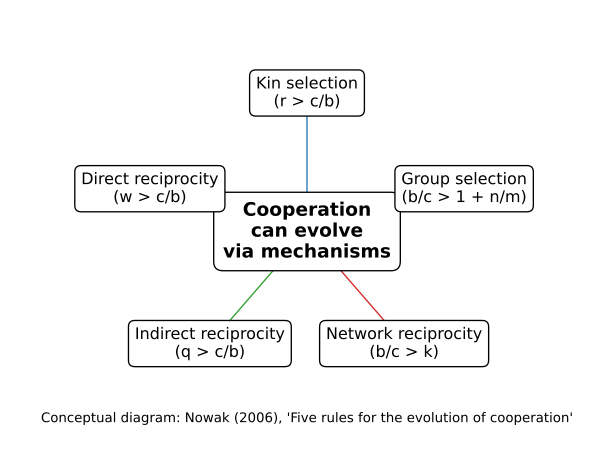
The important contemporary nuance:
- “Cooperation” can mean helping kin (inclusive fitness), trading favors, reputation and signaling, clustered networks, multi-level selection, institutions, and more.
- These mechanisms can coexist and reinforce each other.
This is where the Darwin–Kropotkin “debate” becomes productive: it’s less about whether cooperation exists, more about which ecological/social structures select for it.
5) From biology to society: how to not commit category errors
A clean way to avoid confusion:
- Evolutionary biology: describes how traits spread under selection/drift in populations.
- Social/political theory: evaluates how societies should be organized, with ethical commitments, historical context, and power relations.
You can still build bridges, but you have to keep two dangers in mind:
1) Naturalistic fallacy: “X happens in nature → X is good.” (No.) 2) Just-so politics: “My politics is natural → therefore true.” (Also no.)
The responsible bridge is: use models as intuition pumps, then bring in institutions, ethics, and history.
6) Commons, institutions, and why “free-rider” is not destiny
Garrett Hardin’s famous “Tragedy of the Commons” essay popularized the idea that shared resources inevitably collapse under self-interest. Hardin 1968
Elinor Ostrom’s work showed—empirically—that communities can and do govern commons sustainably through institutions (rules, monitoring, graduated sanctions, conflict resolution, and local legitimacy). Ostrom 1990
This is a nice “third voice” in our story:
- Darwin lens: free-riding is always a threat.
- Kropotkin lens: cooperation is a natural survival strategy.
- Contemporary lens: institutions change the payoff landscape.
In the lab’s Moran mode, the Public Goods (commons) game + “institution strength” parameter is a toy version of this idea.
7) Anarchism is not “no rules”; it’s a theory of rule-making without domination
Since you explicitly asked for Bakunin: Bakunin’s critique of authority (e.g., God and the State) targets hierarchical domination and argues for people governing themselves rather than being governed. Bakunin 1871
There’s a deep link here to Ostrom and to modern complex-systems thinking:
- “No state” does not mean “no institutions.”
- It can mean polycentric, bottom-up, federated rule systems (rules generated by participants, not imposed by distant power).
A closely related contemporary development is social ecology (Murray Bookchin), which argues that many ecological crises originate in social hierarchies and domination, so “fixing nature” requires rebuilding social relations—not just changing individual consumer behavior. Bookchin 1993
And “mutual aid” is not just a 19th‑century phrase. In contemporary movements, writers like Dean Spade emphasize mutual aid as horizontal, reciprocal care and organizing (as opposed to top‑down charity), explicitly in conversation with Kropotkin’s tradition. Spade 2020
You can read this as a design problem: how do we create coordination (and constrain cheating) without building a machine that becomes its own predator?
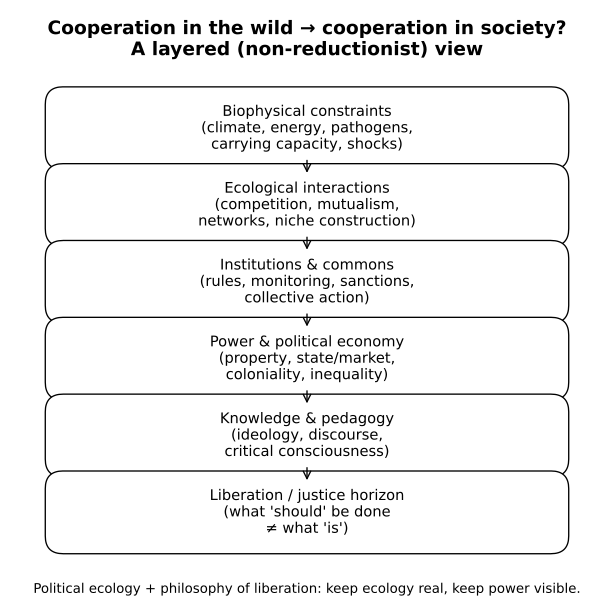
8) Political ecology: cooperation is also about power + environment, not just “preferences”
Political ecology studies how power relations and economic structures drive environmental change, and how access to resources is distributed (often unjustly). Roberts 2020
This is crucial for Darwin vs Kropotkin because it adds a missing variable: who controls the environment that sets the payoffs.
If the “environment” is politically produced—via enclosure, extractive economies, colonial histories—then “cooperation” is not only a biological strategy, it is also a struggle over:
- property regimes,
- labor and risk distribution,
- who gets to decide what counts as “rational.”
9) Philosophy of liberation and pedagogy: why the “third voice” refuses to be neutral
The Latin American Philosophy of Liberation tradition explicitly treats philosophy as practical and situated: thinking from the standpoint of dependency, oppression, and liberation. Mendieta 2016
Enrique Dussel frames liberation philosophy as beginning from historical/geo-political conditions rather than pretending to be view-from-nowhere. Dussel 1985
Paulo Freire’s pedagogy emphasizes conscientização (critical consciousness) and praxis (reflection + action), arguing that liberation is a mutual process, not a gift. Freire (IEP)
Why is this relevant here?
Because the Darwin–Kropotkin debate isn’t only about mechanisms; it’s also about what stories do, and who benefits from which story.
A “third voice” can say:
- Biology teaches humility: cooperation is fragile; cheating is real.
- Sociology teaches sobriety: power shapes “environment” and incentives.
- Liberation thought teaches orientation: analysis should be accountable to those harmed by the system.
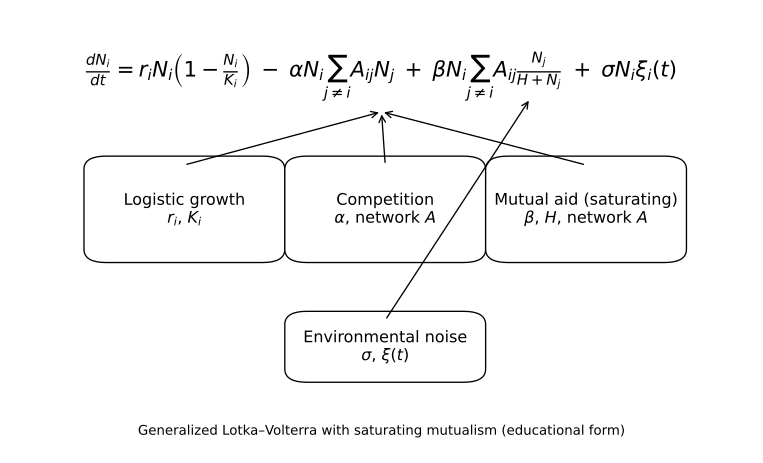
10) The Lab: compare two model families
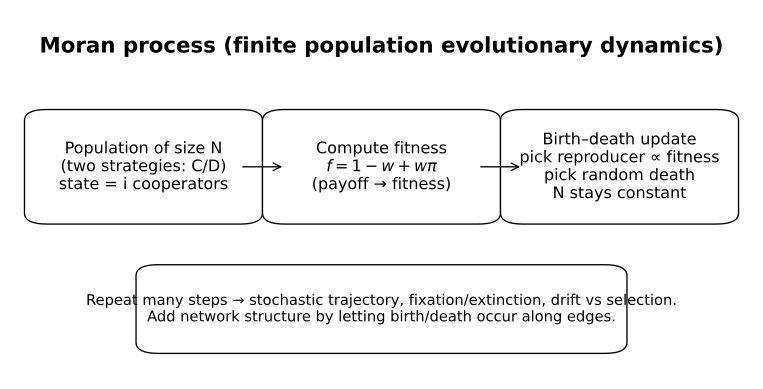
(B) Moran mode: finite-population evolutionary game dynamics (drift + selection), with optional network structure and a toy “institution” knob.
How to use it (recommended path)
- Start in Moran mode → Prisoner’s dilemma → well-mixed (Darwin lens). Watch defection tend to dominate.
- Switch to network structure (Kropotkin lens). Clustering can protect cooperators.
- Try Public goods (commons) with and without “institution strength” (contemporary lens).
11) The three-voice debate (Darwin · Kropotkin · Contemporary)
References
-
Darwin, Charles. 1871. The Descent of Man, and Selection in Relation to Sex. Chapter IV (“The moral sense”), public-domain text.
Wikisource edition. -
Huxley, T. H. 1888. “The Struggle for Existence in Human Society” (excerpt/selection from Evolution and Ethics), public-domain text.
Fordham Sourcebook. -
Kropotkin, Peter. 1902. Mutual Aid: A Factor of Evolution. Public-domain text.
Marxists Internet Archive. -
Nowak, Martin A. 2006. “Five Rules for the Evolution of Cooperation.” Science 314(5805): 1560–1563. DOI: 10.1126/science.1133755.
PubMed record. -
Hardin, Garrett. 1968. “The Tragedy of the Commons.” Science 162(3859): 1243–1248.
PDF (University of Chicago mirror). -
Ostrom, Elinor. 1990. Governing the Commons: The Evolution of Institutions for Collective Action. Cambridge University Press.
See also: Ostrom’s Nobel Prize lecture (design principles summary): PDF. -
Bakunin, Mikhail. God and the State (posthumous publication; commonly dated to the early 1870s).
Marxists Internet Archive · Project Gutenberg. -
Roberts, J. 2020. “Political ecology.” Anthropology Encyclopedia (overview/definition).
Online entry. -
Mendieta, Eduardo. 2016. “Philosophy of Liberation.” Stanford Encyclopedia of Philosophy.
SEP entry. -
Dussel, Enrique. Philosophy of Liberation. (Primary text; various archival PDFs circulate.)
Bibliographic record: PhilPapers. -
“Paulo Freire (1921—1997).” Internet Encyclopedia of Philosophy (IEP). Overview of Freire’s life and Pedagogy of the Oppressed.
IEP entry. -
Bookchin, Murray. 1993/2007. “What is Social Ecology?” (essay; widely reprinted online).
Anarchist Library. -
Spade, Dean. 2020. Mutual Aid: Building Solidarity During This Crisis (and the Next). (Contemporary movement text.)
Verso description.